We decided to visit El Salvador only in the past few weeks, but boy are we happy we did!. We could write 10 posts about this country (maybe we should have), so this is a long one.
On arrival we were guided by Bill, the moorings manager, over the bar (sandbank) through the entrance into the river and after docking we were welcomed with a cold slightly alcoholic drink.
On the river there is a very active local community living from fishing and tourism. There is a small marina, part of a resort between the ocean and the river, but we decided to put Sunriser on a mooring ball, managed by Bill. Because the river is not very deep and is tidal, people build restaurants on stilts. There are also restaurants on the riverbank, which get flooded with high water so you tie up your dinghy right next to your table.


On a 20 minute dinghy ride through the mangroves we arrived at the nice village Herradura. Hardly any tourists ever come here, and we were warmly welcomed by the locals. It is a lively village with lots of street vendors; we tried there for the first time the national dish, the Pupusa, a filled round bread.


El Salvador is a small country and, due to years of civil war and gang violence, not a tourist destination. In a matter of five years it has gone from being one of the most dangerous countries in the world to the safest country in central America, since the government of Najib Bukele. We were very curious to see how he has managed to drastically change the country so fast and how the people feel about it.
We started our round tour in the small town of Zacatecoluca, on market day, a burst of colour and activity. A lot of the commerce still takes place by street vendors, unlike in the tourist places San Salvador and Santa Ana, where they have been relocated in halls or sent out of the city center.
Before the traffic chaos of San Salvador we had a small stop at Devil`s gate, a view point at the mountains, very popular among Salvadorians


In San Salvador the history of the civil war of 1980 to 1992 is not forgotten, with a monument to the thousands of victims, many of them children soldiers. On Youtube there is a movie on this. Some names have a different color, these are the people that were assumed dead, but instead escaped. The church plays a very important role in the Salvadorian life, as we could see when visiting the memorial of murdered bishop Oscar Romero, who raised his voice against the violence.
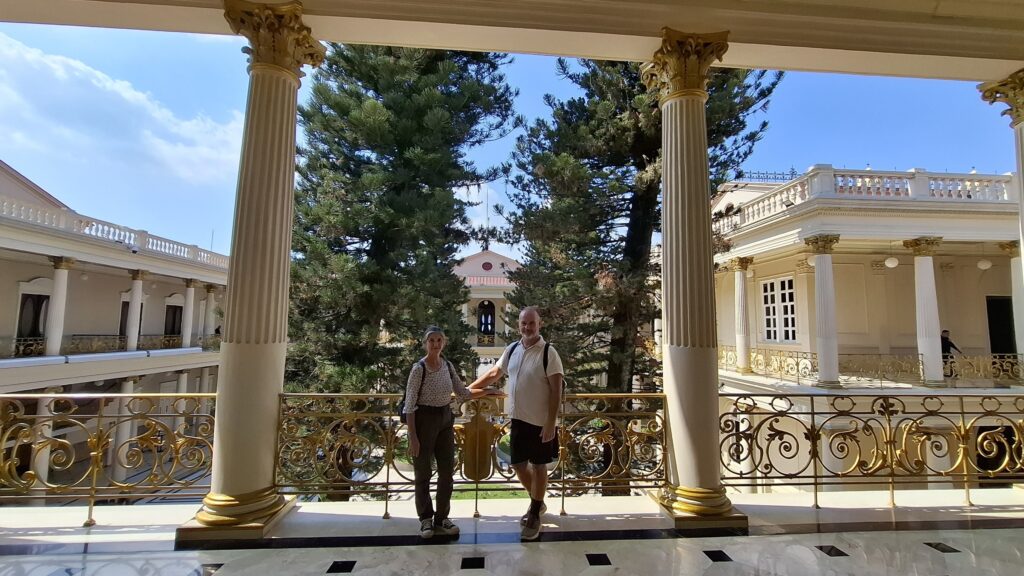
The government is clearly making huge investments to attract tourism. The graffiti of the gangs have been replaced. The presidential palace has been beautifully restored and is since short open to the public. Also, an impressive modern library has been built with money from China. Here the children can play computergames, but only after they have read a book for 45 minutes and answered correctly the questions about the book.


Unlike in neighbouring Guatemala, the indigenous people of El Salvador have not been able to preserve their customs and language. A facist regime in the 1930’s, praised by Hitler, wiped out the Pipil population. Only two archeological sites can still be visited: the temple of Tazumal and Joya de Ceren (the Pompei of America), the remains of a village buried under a volcanic eruption.


As if this and 12 years of civil war was not enough, El Salvador has suffered in this century years of extreme gang violence, brought by those traumatized youngsters who fled during the civil war to the USA and there fell prey to criminal bands. When finally peace was signed they were deported back to a destroyed country with no future and, sadly, they imported the criminal violent culture with them.
We have heard terrible stories from first hand of people who suffered the terror of the gangs; a life where nobody was safe. Falling asleep in the bus and ending up in the wrong neighbourhood could mean death, as well as wearing the wrong clothes or shoes; boys were always in fear of being recruited by the gangs and girls of attracting the attention of a gangster. All businesses had to pay extortion money, even poor street vendors, under threat of death. And, thus, the country was virtually in the hands of the gangs, and up until the election of Najib Bukele no governement was able to do anything.
And then, in 2019, Najib Bukele was elected and started with the massive imprisonment of all people who even remotely could be involved with the gang violence. Many of them were recognized by their characteristic tatoos which they got after comitting at least one murder, a necessary rite of passage to join the gang. At this moment it is estimated that 2% of the population is imprisoned, of which some just by being in the wrong place at the wrong time.
In the small town of Santa Ana they told us of the curfew imposed by the gangs so they could kill freely at night, and later the raids of the police searching house by house and checking the people for tattoos. Now this colonial town has restored its cathedral and theater and is starting to receive tourists with open arms.


So, how do the Salvadorians actually feel about it? Well, to start with, in 2024 Bukele was reelected with 83% of the votes. Everybody we talked to was absolutely happy to finally live in peace and without fear. However, people are well aware that the country is sliding towards a dictatorship, even if it is under the coolest dictator on the planet. There is no freedom of press already, with dissident journalists either imprisoned or exiled. Further concerns are raised in respect of the economy and Bukele`s experiment with the bitcoin and gold mining. But the general sentiment is rather “Time will tell”.
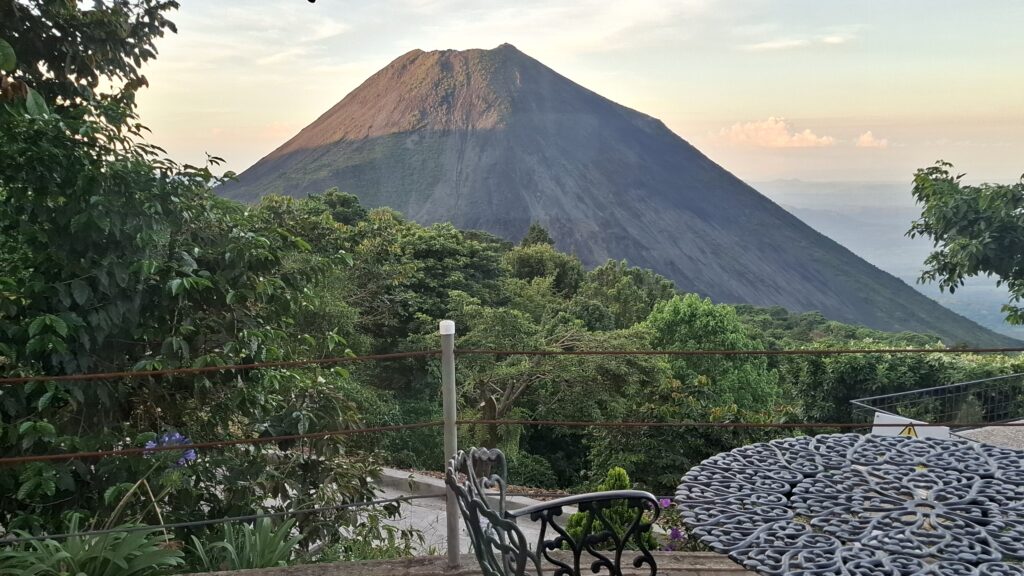
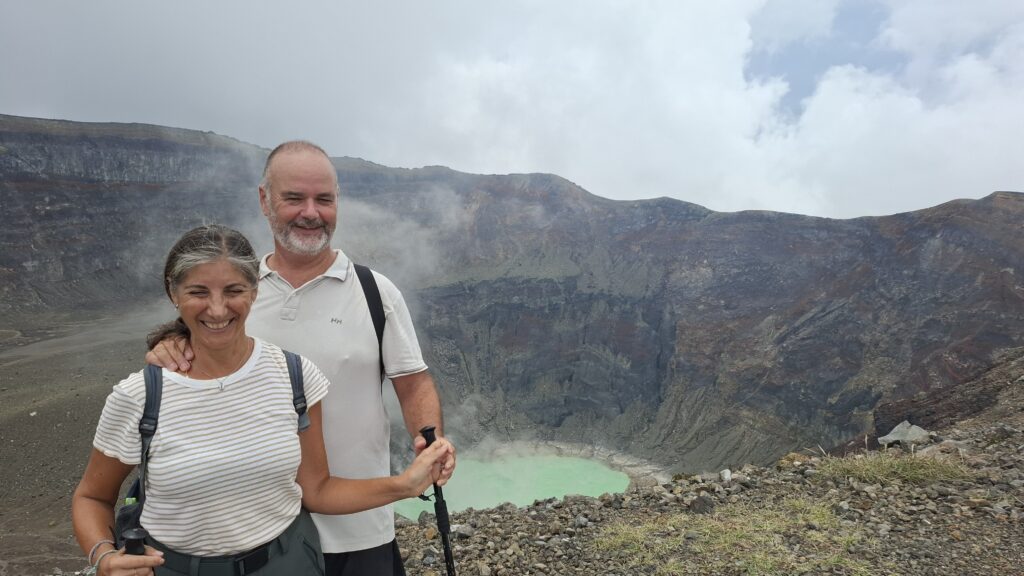
We were very impressed by the stories and the resilience of the people in San Salvador in Santa Ana. Although the criminality was generalized, the extreme violence was luckily limited to the cities, as we learned on our next trip to the countryside. We visited pittoresque villages like Juayua in the flower route, hot springs, a coffee plantation and, of course, hiked up the Santa Ana volcano, the highest volcano in El Salvador, which we actually can see from the boat.


Unfortunately during our roundtour we had lightning hitting Sunriser. Fixing this is still work in progress, but the first steps you can read here.
We were so enchanted with the area that we are going to leave the boat behind on this place. As labour is very affordable here we hired people to wax the boat, clean the bottom. And as the river has a lot of silt we can not use our watermaker, so water was delivered. Interesting detail: The pastor of the village (who preaches through a BIG loudspeaker on Sundays), did with some of his parishioners the waxing, the cleaning of the bottum and brought the water. Together with a concrete block of 2000 kilo where our boat is chained to, this should be safe to leave Sunriser behind.
We did our own list of things to prepare for leaving: taking of the sails and about 30 other jobs.


We will now go to the Netherlands during hurricane season, officially this lasts from 15 May to the end of October, but we will go back a bit earlier than that.
.
Prachtig verhaal weer, Jos en Beatrice. Wat een avonturen. Met veel plezier gelezen op jullie mooie website